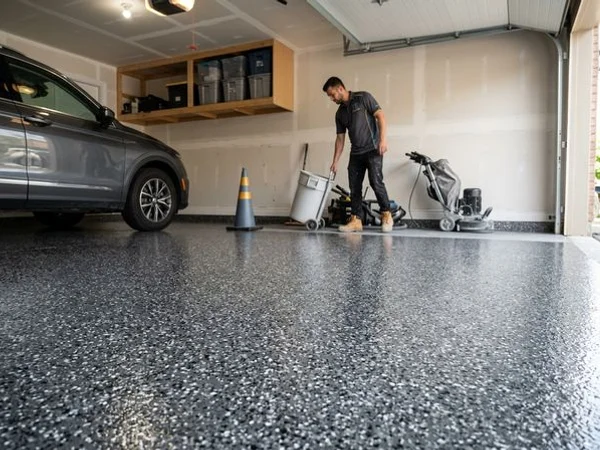
Automotive Service Bay Epoxy in Ottawa & the National Capital Region - Dealership, Oil Change & Workshop Floor Systems
Serving federal, municipal, and independent shop clients across the National Capital Region, Ottawa Epoxy Flooring engineers heavy-duty coating systems for dealership service floors, quick-lube pits, transmission bays, collision refinishing shops, and fleet maintenance facilities throughout Ottawa, ON. Vinyl-flake, broadcast-quartz, and solid-colour 100% solid epoxy specifications are matched to lift loads, drainage layout, and chemical exposure on a bay-by-bay basis, with polyaspartic finish coats rated for petroleum immersion and hot-tire pickup.
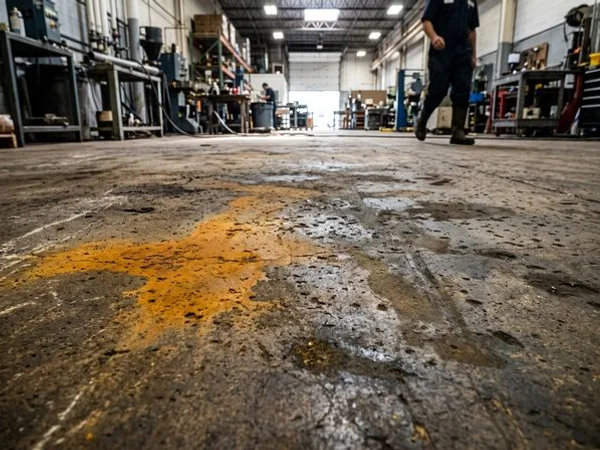
What kills residential-grade paint in an auto bay is not one failure mode but four stacked on top of each other. Two-post, four-post, scissor, and inground hoists concentrate 6,000 to 12,000 lb point loads at their anchor pads, and any 40 to 60% solids waterborne paint sitting under that footprint delaminates inside the first year. Oil, ATF, gear oil, and DOT brake fluid soak 10 to 15 mm into unsealed concrete over years of drips, and coating over that saturation without alkaline degreasing and hot-water extraction produces a bond to the hydrocarbon film rather than the slab. Verification comes from the grind-dust colour check: if the dust reads orange, decontamination is not finished. On top of all that, ASTM D2047 wet coefficient of friction for a service environment cannot be met by bare epoxy alone. Aggregate broadcast is mandatory, not decorative.
A two-bay independent shop of 1,200 to 1,600 sq ft typically wraps in one to two days. Larger dealership service departments in the 8,000 to 20,000 sq ft range are phased overnight bay-by-bay to keep the ticket board active during the day. Installed pricing runs $6 to $12 per sq ft based on hoist pad count, degree of oil saturation, and drainage detailing. WSIB certification and $2M liability are documented on every contract.
Coverage extends across the NCR from central Ottawa through Kanata, Nepean, Orleans, Barrhaven, Stittsville, Manotick, Rockcliffe, Vanier, and out into Gatineau, Kemptville, Arnprior, Rockland, and Carp.
Automotive Service Bay Epoxy Flooring in Ottawa
Broadcast-quartz and solid-colour 100% solid epoxy systems are our default specification for dealership service departments, independent shops, quick-lube facilities, and collision workshops across Ottawa and the NCR. Ottawa Epoxy Flooring engineers each bay around the actual loads, the actual chemistry, and the actual traffic pattern. Petroleum decontamination, hoist-pad reinforcement, and ASTM D2047 aggregate broadcast are line items on every quote, not upsells, because that is what separates a service floor that outlasts the warranty from one that peels in under a year.
What Is Automotive Service Bay Epoxy?
Service bay epoxy is a purpose-engineered 100% solid coating system built around three failure modes that hobbyist garage kits cannot address: petroleum contamination in the substrate, concentrated hoist point loads, and the ASTM D2047 wet slip threshold for commercial vehicle service. A residential garage floor coating skips all three. Automotive systems layer in decontamination protocols, reinforced lift-pad footprints, and aggregate that keeps the coefficient of friction above spec even when the floor is contaminated with oil.
What Does an Automotive Bay Epoxy System Include?
- Petroleum decontamination and hot-water extraction verified by grind-dust colour
- Diamond-ground CSP 3 profile
- 100% solid epoxy base coat
- Reinforced hoist-pad zones rated for 6,000 to 12,000 lb concentrated loads
- Quartz aggregate broadcast meeting ASTM D2047 wet slip resistance
- UV-stable polyaspartic finish that resists hot-tire pickup
- Seamless floor-to-drain detailing
How Much Does Automotive Service Bay Epoxy Cost
Installed pricing across Ottawa and the NCR runs $6 to $12 per sq ft. The variables are system chemistry, hoist pad count, and petroleum saturation depth. A two-bay shop typically lands between $8,000 and $15,000 complete.
Why Our Climate Demands a Higher-Grade Automotive Floor
Ottawa winters push service floors past failure conditions that milder markets never see. Road salt tracked in from November through April is mildly corrosive to standard coatings, and with 224 cm of average annual snowfall the salt load in an Ottawa shop is among the heaviest in Ontario. Somewhere between 80 and 100 freeze-thaw cycles per winter drive crack propagation at control joints and drain edges, particularly where petroleum has already weakened the substrate. A service floor rated for five years in a moderate climate can fail here in eighteen months if the wrong system goes down.
Condensation is the other Ottawa-specific factor. Open a shop door in January and warm interior air meets a cold slab, depositing a film of moisture on the concrete surface. Standard epoxy primers over that film bond to water rather than concrete and let go at high-stress points within weeks. Our moisture-tolerant primer chemistry is specified precisely for this condition and holds adhesion on damp substrates where conventional primers cannot.
Chemical and Fluid Resistance for Service Environments
Motor oil, fuels, antifreeze, DOT 3 and DOT 4 brake fluid, ATF, gear oil, and industrial degreasers all pass through a service bay in a normal week. Our commercial-grade epoxy forms an impermeable film that shrugs off these chemistries and keeps them from staining or corroding the substrate underneath.
Decontamination happens first, always. Alkaline degreaser goes down, hot-water extraction pulls the hydrocarbon load, and grinding proceeds only after the dust colour reads clean. We monitor that dust because orange tinting means oil is still present and the coating is being asked to bond to a contaminated surface. Most installers omit this step entirely, which is why we are so often called in to redo their work.
The 100% solids epoxy we specify carries a chemical resistance profile far above the 40 to 60% solids waterborne alternatives. Paired with a hot-tire resistant polyaspartic topcoat, the finish stays clear and hard through daily petroleum exposure without yellowing or softening. Merivale Road dealership service floors and Kanata independent shops are our most frequent automotive clients, environments where petroleum contact is constant rather than incidental.
Load Capacity and Hoist Pad Reinforcement
Lifts, tool carts, and tire dollies cycle service bays through concentrated load events every hour. Two-post and four-post hoists apply 6,000 to 12,000 lb point loads at their anchor footprints, and for that reason 100% solids epoxy is our non-negotiable specification at every hoist-pad zone. A 40 to 60% solids waterborne coating simply crushes and delaminates under those loads because the cured film is too thin and too porous to distribute the force.
Our epoxy bonds mechanically to the shot-blasted or diamond-ground substrate and spreads the anchor load across the full footprint rather than a single stress point. Showrooms and drive lanes get the same base with a polyaspartic finish coat over top to defend against tire scuffing and thermal marking. Nepean fleet maintenance facilities running diesel trucks and forklifts get thicker high-build layers in the loading zones to absorb the additional impact and abrasion.
Anti-Slip Safety for Wet Petroleum Environments
Traction cannot drop just because the floor is contaminated with oil. Quartz aggregate, aluminium oxide, or polymer grit is broadcast into the epoxy matrix to hold the wet coefficient of friction above the ASTM D2047 threshold for commercial vehicle service. The result is a floor that stays clean and easy to mop but never becomes a slip hazard when a hydraulic line drips.
Gloss and texture get tuned to each bay’s function. High-gloss finishes brighten the space and improve inspection visibility, but they demand additional aggregate in any zone that sees liquid contact. Detailing bays, wash drains, and hoist areas each get their own traction spec because their duty cycles are not the same. A seamless surface throughout eliminates the cracks and joints where debris collects and trip hazards develop.
| Feature | Benefit |
|---|---|
| 100% solid epoxy | Superior chemical and hoist load resistance |
| Polyaspartic topcoat | UV stability and hot-tire pickup protection |
| Seamless finish | Hygienic, easy-to-clean surface |
| Anti-slip aggregate | ASTM D2047 wet traction for petroleum environments |
| Petroleum decontamination | Long-term adhesion over oil-saturated concrete |
Epoxy Flooring Systems for Auto Shops
System selection is tuned to the mechanical loads, chemistry, and hygiene expectations of each bay type. Every specification balances durability, application window, and appearance against the operational reality of an active shop.
Quartz-Filled and Self-Levelling Epoxy Systems
Self-levelling epoxy with quartz aggregate gives you the strongest combination of chemical resistance, wet traction, and a truly seamless surface for zones that see oil and cleaning solutions daily. High-build application flattens minor slab variation and resists abrasion from rolling toolboxes and low-speed vehicle movement. The aggregate itself reinforces the film and evens out visual tone across the bay.
Petroleum decontamination is the prerequisite that makes any of this work. Grinding to CSP 3 opens the pore structure so the epoxy anchors mechanically to sound concrete rather than a hydrocarbon film. Hoist pad zones receive 100% solids epoxy at the anchor footprint because the concentrated loads there crush budget-grade coatings within months.
Metallic Epoxy and Decorative Flake Finishes
Metallic epoxy and vinyl flake broadcast pair heavy-duty performance with a customer-facing appearance suited to dealership showrooms and service drives. Reflective pigments and coloured chips add depth and visual contrast while the underlying build holds up to service-drive tire contact and cleaning cycles.
Resin selection is matched to the chemistry and traffic pattern first, appearance second. Vinyl chips are broadcast into a wet base coat and locked under a clear polyaspartic finish for full wear protection. Metallic pigments settle into pattern variation as the resin cures, distinguishing customer reception areas that need brand differentiation. Kanata and Nepean dealerships with heavy foot traffic through their service drives frequently specify a decorative flake system exactly for this reason.
Polyaspartic Coatings for Fast Turnaround
Same-day or next-morning return-to-service is the driver behind polyaspartic coatings in busy shops. Applied over an epoxy primer, polyaspartic finishes build chemical and abrasion resistance while collapsing the cure window into a few hours. Hot-tire pickup, the failure mode that plagues standard urethane finishes in high-turnover bays, does not affect an aliphatic polyaspartic film.
Ottawa’s swing from summer heat to sub-zero winter is exactly the kind of temperature range polyaspartic handles well, and it holds gloss and colour for years without yellowing. Low odour and a short recoat window make it a natural fit for overnight bay work. A light abrasive screening and topcoat refresh every five to seven years restores traction and surface clarity without stripping the base system.
Professional Surface Preparation and Installation
Preparation and application follow a repeatable protocol that protects adhesion and locks in long-term reliability. Each phase targets the substrate uniformity, structural condition, and chemical tolerance the bay actually needs to survive.
Mechanical Diamond Grinding and Surface Profiling
Mechanical diamond grinding kicks off every project. Surface contaminants, existing coatings, and weak laitance come off, and industrial HEPA vacuum attachments keep the airborne dust load down. Grinding to CSP 3 delivers the profile depth that lets the epoxy mechanically anchor into sound concrete.
On oil-saturated slabs, petroleum decontamination precedes any grinding pass. That sequence keeps hidden hydrocarbons from bleeding back into the surface during profile creation. Slab porosity and wear pattern get read as we go so grit progression can be adjusted to hit uniform depth without removing more concrete than the bond requires.
Crack Repairs and Moisture Testing
Cracks, both visible and subsurface, get repaired with flexible epoxy mortar and structural fillers before the coating goes down. Each repair is engineered to bridge minor future movement while blending flush to the finished surface. Moisture vapour analysis follows using either ASTM F1869 calcium chloride testing or in-slab digital probes, and readings must land below 3 lbs per 1,000 sq ft per 24 hours before priming.
The city’s Leda clay soils drive elevated vapour emission through slab-on-grade automotive shop floors, especially in buildings that predate modern vapour-barrier requirements. Where excessive moisture or vapour drive is detected, we apply a moisture mitigation primer to prevent future blistering under the finish coats.
Bay-by-Bay Application and Return to Service
Every hoist-pad zone gets 100% solids epoxy because thinner formulations crush under repeated lift loads. General coverage layers up as a high-build base coat under a hot-tire resistant polyaspartic topcoat. Coats cure overnight inside a bay-by-bay rotation, so the shop keeps operating throughout the install. Quartz or flake aggregate is broadcast at full coverage rates and thickness is checked before the next layer is added.
Related Questions Auto Shop Owners Ask
Why does epoxy fail so quickly on some automotive shop floors?
Two causes account for almost every failure we are called in to repair: petroleum-contaminated concrete that was coated without decontamination, or 40 to 60% solids paint specified where a 100% solids system was needed under lifts. Oil migrates 10 to 15 mm into concrete over years of drips. A coating placed over that saturated substrate bonds to the hydrocarbon film rather than the concrete and releases within three to six months regardless of which manufacturer’s product was used.
Can a quick-lube or oil change bay get a different spec than a full service bay?
Yes, and it usually should. Quick-lube pits see constant oil contact but no vehicle hoist loads. Petroleum resistance and slip control on wet oily surfaces are the primary requirements, so a broadcast quartz system with full aggregate coverage and seamless drain transitions is the right call. Full service bays add hoist-pad reinforcement because lift loads change the load picture entirely. Transmission rebuild and heavy mechanical bays may layer in additional high-build for impact resistance from dropped tools and heavy equipment movement. Each bay’s actual use gets assessed before we write the specification.
How do independent shops schedule floor installations without losing revenue?
Two to six bay shops usually run the whole project in two to four overnight phases across a Monday-to-Thursday work week. The shop keeps its normal daytime service schedule and our crew arrives after closing. Each bay is clear for vehicle return by the following morning. Larger dealership departments with ten to twenty bays run phased sections across two to three weeks of overnight work. The scheduling variable that matters most is whether two-post hoists can be temporarily lowered. If yes, everything else works around fixed equipment without any lift removal.
Do EV service bays need a different epoxy specification than ICE vehicle bays?
For most EV work at dealerships, the same 100% solid epoxy and polyaspartic system used on internal combustion bays is appropriate. The distinction that matters is battery pack service, where high-voltage systems and static-sensitive components introduce ESD considerations. Facilities that regularly service EV battery packs should evaluate an ESD-dissipative topcoat for those specific zones. Standard tire, suspension, and brake work in an EV bay is well within the performance envelope of a standard automotive epoxy system.
Auto Service Bay Epoxy Pricing
Oil decontamination depth and hoist lift pad count affect final price.
Why Ottawa Customers Choose Ottawa Epoxy Flooring for Auto Service Bay Epoxy
Petroleum Decontamination Included
On slabs that have been in service for years, oil migration reaches 10 to 15 mm. Our crews apply alkaline degreasers, hot-water extraction, and a grind-dust colour verification pass before any primer. Skipping this step is the number-one reason competitor floors fail inside six months on contaminated concrete.
100% Solids at Every Hoist Pad Zone
Anchor pads under a two-post hoist see 6,000 to 12,000 lb concentrated loads on every cycle. That zone gets 100% solids epoxy full stop. Budget-grade 40 to 60% solids paint fails at anchor footprints within months and we simply do not specify it under lifts.
Hot-Tire Resistant Polyaspartic Topcoat
Warm rubber grabs standard urethane finishes and lifts them off the floor. The aliphatic polyaspartic we specify holds up under repeated hot-tire contact, keeping the surface free of scuff pickup and tire transfer for the full service life.
Bay-by-Bay Overnight - Shop Stays Open
Work rotates through your bays overnight. The service department runs its normal ticket board during the day, and each finished bay is back in service the next morning. No full-shop closure is ever required.
How Auto Service Bay Epoxy Works
Oil Contamination Assessment
Every slab is inspected for petroleum saturation depth before prep begins. A grind-dust colour test tells us how deep the contamination has migrated and dictates the decontamination pass required.
Petroleum Decontamination & CSP 3
Alkaline degreaser is applied, followed by hot-water pressure extraction and diamond grinding to CSP 3. A second grind-dust colour check confirms the hydrocarbon load has cleared before any primer sees the slab.
Bay-by-Bay System Application
Overnight shift work rotates through each bay: 100% solid epoxy base coat, additional lift-pad reinforcement at anchor footprints, quartz aggregate broadcast, and a UV-stable polyaspartic topcoat.
Slip Test & Drain Detailing
Wet coefficient of friction is verified against ASTM D2047 after aggregate broadcast. Drain transitions are dressed seamlessly and any required safety-zone striping is laid down before vehicles come back in.
Ready for a Free On-Site Assessment?
Same-day quotes across Ottawa. WSIB-certified, $2M liability on every project.
What Customers Say About Our Auto Service Bay Epoxy
"Twelve-bay dealership service floor on Merivale, and our previous coating gave out around the hoist anchor pads every couple of years. The Ottawa Epoxy crew ran the alkaline degreaser and I watched them recheck the grind dust before they would prime a single square foot. A full year of two-post and four-post cycles later, the lift zones look identical to day one. Overnight scheduling meant no lost appointments."
"Independent four-bay shop in Kanata. Old floor stained straight through and the drain edge was peeling. Nobody had ever bothered with proper decontamination before. This crew did. The quartz broadcast holds traction even when the floor gets slick with oil, and after eight months the polyaspartic still has zero tire marks."
"Nepean fleet maintenance facility. Diesel trucks and forklifts on the floor every day, hydraulic lines that occasionally leak, and mechanics who need traction. Ottawa Epoxy reinforced the hoist pads and ran 100% solid epoxy edge to edge. Four overnight phases, no shutdown, and the anti-slip broadcast handles everything we throw at it."
Auto Service Bay Epoxy FAQs
Which epoxy system works best for an automotive service bay?
Service bays call for a 100% solid epoxy applied over a CSP 3 diamond-ground profile, with petroleum decontamination done first, reinforcement built into every hoist pad footprint, and quartz aggregate broadcast for wet traction under ASTM D2047. Budget 40 to 60% solids paints simply do not last under lift loads combined with petroleum contact and typically fail within six to twelve months. A properly specified 100% solids system delivers long service life in an active shop.
How do you handle a slab that is already saturated with oil?
Decontamination is the single most important step, and we treat it that way. Alkaline degreaser is applied first, then hot-water pressure extraction opens the pores. During diamond grinding, we monitor the dust colour. Orange-tinted dust means residual hydrocarbons are still present and additional treatment is required. Skipping the verification step is what causes competitor floors to release inside three to six months regardless of the resin they used.
What surface prep and moisture thresholds apply, and how do diamond grinding and shot blasting compare?
Diamond grinding to CSP 3 preceded by petroleum decontamination handles most automotive bays and opens the pore structure without cutting into the structural slab. Shot blasting comes into play on heavily contaminated slabs or large footprints where consistent profile across a wide area matters. Moisture vapour must remain under 3 lbs per 1,000 sq ft per 24 hours by ASTM F1869, and in-slab relative humidity under 75 to 80% before priming. Both readings are logged before any coating goes down.
How do quartz, vinyl flake, and solid-colour systems compare for auto bays?
Quartz-filled broadcast delivers the densest aggregate and the highest wet slip rating, which is what technicians need in oily zones. Vinyl flake broadcast adds visual depth and hides oil staining between cleanings, so it is a natural fit for customer-visible service drives. Solid-colour high-build epoxy is the workhorse for production bays where cleanliness and quick visual inspection matter most. All three accept a polyaspartic topcoat for hot-tire resistance and UV stability.
What should I budget for auto service bay epoxy in Ottawa?
Installed pricing across Ottawa and the NCR runs $6 to $12 per sq ft. The variables are system chemistry, hoist pad count, and how deep the petroleum contamination has migrated into the slab. A two-bay independent shop of 1,200 to 1,600 sq ft typically lands between $8,000 and $15,000 complete in one to two days. Dealership service departments are scheduled in phased overnight sections.
Can the floor go in without pulling out our hoists?
In most cases, yes. Two-post hoists can be dropped to their lowest position so we can work around the anchor footprint. Four-post drive-on lifts can be rolled aside to open sections of the slab, then repositioned. Inground pit lifts require a phased schedule that sequences work around the fixed equipment. Two to four bay shops almost always complete without removing a single hoist.
What is the typical install timeline for a service bay floor?
One to two days covers surface prep and coating on a two-bay shop of 1,200 to 1,600 sq ft. Vehicles come back to the bays 24 to 48 hours after the final coat. For dealership departments in the 8,000 to 20,000 sq ft range, we schedule phased overnight or weekend sections so the shop keeps writing tickets throughout.
Does this system stand up to brake and transmission fluid?
Yes. A 100% solids epoxy base under a polyaspartic finish resists motor oil, ATF, gear oil, DOT 3 and DOT 4 brake fluid, power steering fluid, coolant, and diesel fuel at the concentrations and contact durations that occur in normal service work. Concentrated brake fluid should be wiped rather than allowed to pool for extended periods, but incidental contact does not degrade the film.
Automotive Service Bay Epoxy Flooring by city
Local pages with area-specific detail across the NCR:
Automotive Service Bay Epoxy Flooring in Ottawa
Local auto service bay epoxy for Ottawa homes and businesses.
Learn more →Automotive Service Bay Epoxy Flooring in Kanata
Local auto service bay epoxy for Kanata homes and businesses.
Learn more →Automotive Service Bay Epoxy Flooring in Nepean
Local auto service bay epoxy for Nepean homes and businesses.
Learn more →Automotive Service Bay Epoxy Flooring in Barrhaven
Local auto service bay epoxy for Barrhaven homes and businesses.
Learn more →Automotive Service Bay Epoxy Flooring in Orleans
Local auto service bay epoxy for Orleans homes and businesses.
Learn more →Automotive Service Bay Epoxy Flooring in Gatineau
Local auto service bay epoxy for Gatineau homes and businesses.
Learn more →Automotive Service Bay Epoxy Flooring in Rockcliffe Park
Local auto service bay epoxy for Rockcliffe Park homes and businesses.
Learn more →Automotive Service Bay Epoxy Flooring in Vanier
Local auto service bay epoxy for Vanier homes and businesses.
Learn more →Automotive Service Bay Epoxy Flooring in Westboro
Local auto service bay epoxy for Westboro homes and businesses.
Learn more →Automotive Service Bay Epoxy Flooring in The Glebe
Local auto service bay epoxy for The Glebe homes and businesses.
Learn more →Related Services
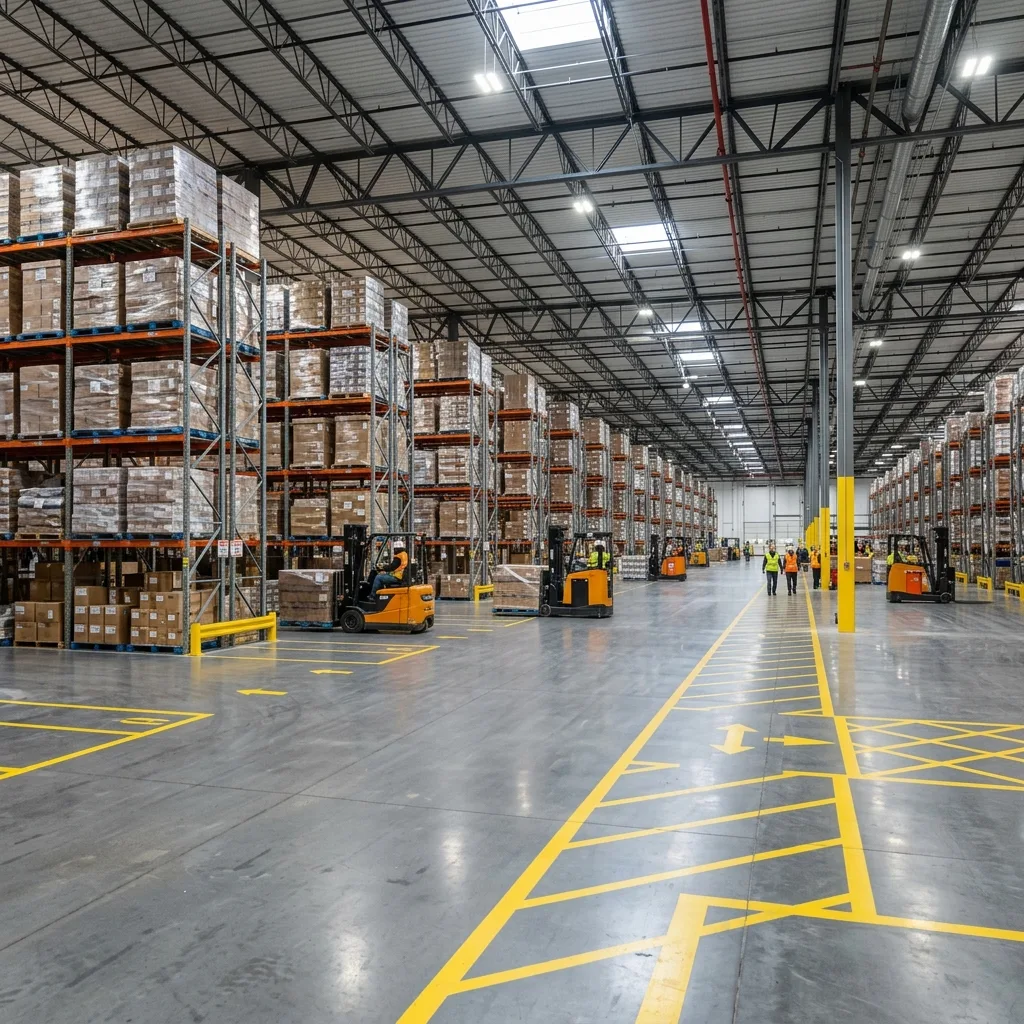
Industrial Epoxy Flooring in Ottawa & the National Capital Region
Heavy-build industrial epoxy for NCR manufacturing plants, distribution warehouses, food processing facilities, chemical storage, and automotive service operations. 80 to 100 mil broadcast systems rated for Class 1 to 3 forklift traffic, 12,000+ lb point loads, and chemical spill exposure. Pricing runs $3 per sq ft for open-plan warehouse epoxy up to $18 per sq ft for novolac chemical-resistant work. WSIB-certified, $2M liability, full compliance documentation.
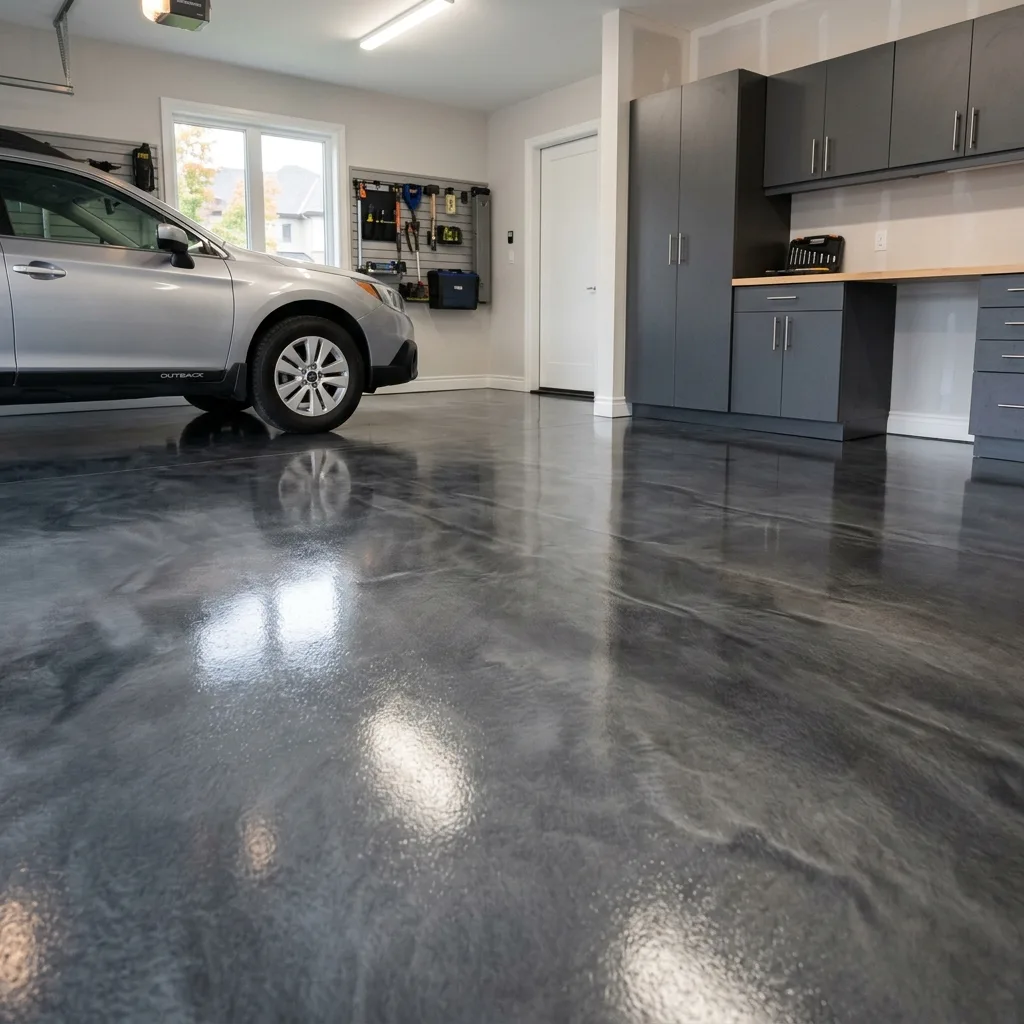
Wash Bay & Washdown Epoxy Flooring in Ottawa & the National Capital Region
Polyurea and urethane cement floor systems for truck wash bays, fleet maintenance shops, food plant washdown zones, and industrial cleaning stations across Ottawa and the NCR. Rated for hot pressure washing, alkaline degreasers, and petroleum contamination. From $7 to $12 per sq ft installed, WSIB-certified with $2M liability.
Commercial Epoxy Flooring in Ottawa & the National Capital Region
Commercial floor systems engineered around the regulatory frameworks that govern federal facilities, restaurants, hospitals, and tech-corridor manufacturing across the National Capital Region. CFIA-compliant kitchens, IPAC Canada coved medical floors, ISO 14644-1 cleanrooms, and high-crossing retail systems. Installed pricing from $5 per sq ft on open warehouses to $22 per sq ft on cleanroom builds. WSIB-certified, $2M liability, full compliance documentation.
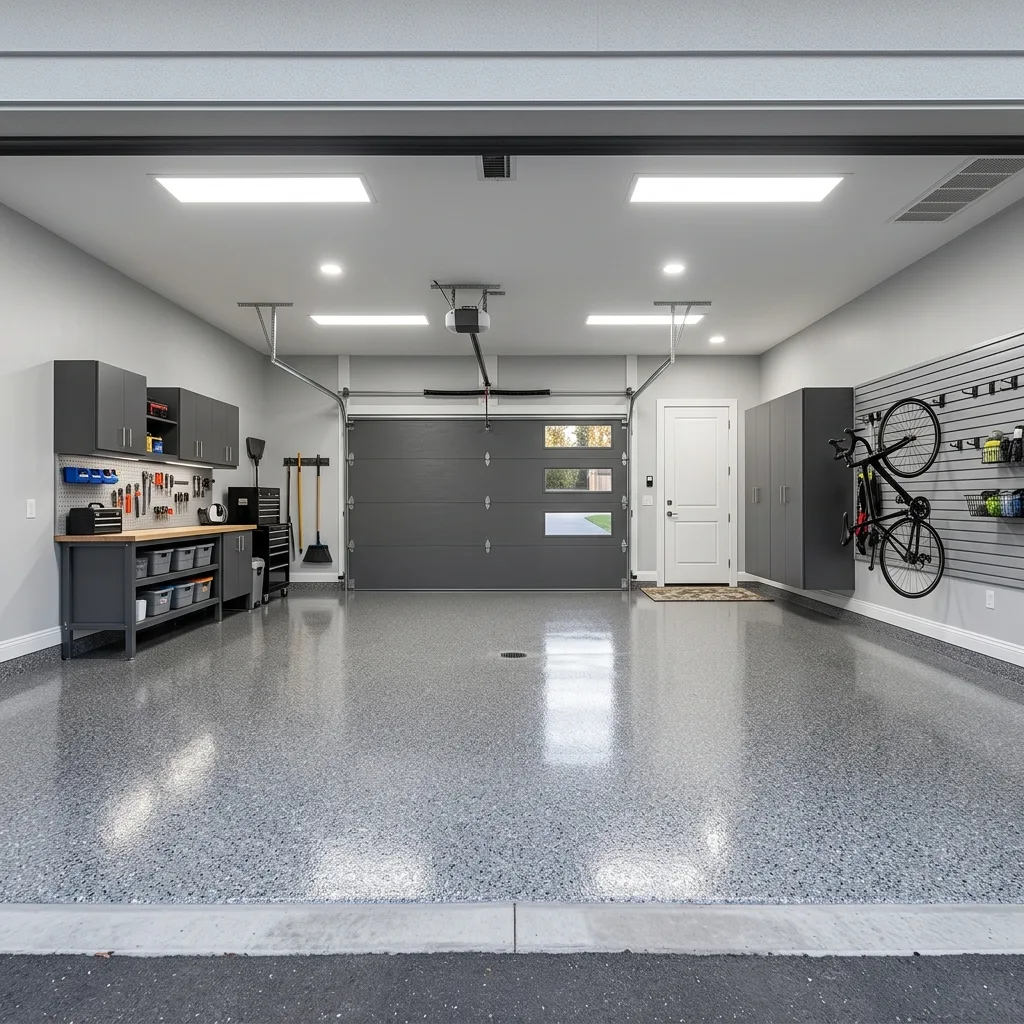
Garage Floor Epoxy in Ottawa & the National Capital Region
Salt-proof, hot-tire-resistant garage floor systems built for NCR winters. Diamond-ground to CSP 3, ASTM F2170 moisture verified, 100% solid epoxy base with quartz or metallic flake, and a UV-stable polyaspartic topcoat. A 400 sq ft single-car garage runs roughly $2,400 to $3,800 installed and wraps in one to two days. Anti-slip grit and WSIB coverage standard.
Secondary Containment Coatings in Ottawa & the National Capital Region
Immersion-rated novolac epoxy, vinyl ester, and polyurea secondary containment coatings for fuel tank berms, chemical storage rooms, transformer pads, and industrial spill floors across Ottawa and the NCR. TSSA-compliant, chemical-profile-specific specifications. From $10 to $18 per sq ft installed with full compliance documentation, WSIB certification, and $2M liability on every project.
Ready to Book Auto Service Bay Epoxy?
Same-day free on-site assessment. WSIB-certified, $2M liability on every project.