
ESD Conductive Epoxy Flooring in Ottawa & the National Capital Region - Anti-Static ANSI-Certified Professionals
For Ottawa facilities that cannot afford a single static event, Ottawa Epoxy Flooring installs conductive and dissipative epoxy floors that carry ANSI/ESD S20.20 certification. Our crews serve federal research labs, Kanata contract electronics manufacturers, NCR data centres, and pharmaceutical cleanrooms across the National Capital Region. Every project ends with megohmmeter verification traceable to NFPA 99 and EOS/ESD STM7.1, plus a written compliance report signed at handover.
The physics on this is unforgiving. A worker crossing a vinyl-tiled floor picks up somewhere between 12,000 and 35,000 volts of static charge, and MOSFET gate oxide in modern semiconductors fails at as little as 10 volts. Damage happens well before anyone senses a shock. To pass audit, the finished floor must sit inside the 1x10^6 to 1x10^9 ohm resistance window under STM7.1 testing. Hitting that target reliably takes calibrated conductive chemistry, a properly laid copper grid tied to building ground, and a full point-by-point resistance map documented after cure.
Most Ottawa jobs run 500 to 5,000 sq ft and finish inside two to four days of site access. Pricing lands between $8 and $15 per sq ft installed, driven mostly by target resistance, grid spacing, and whether the topcoat has to meet cleanroom-grade particle-shed limits. All chemistry is zero-VOC so we can work in occupied buildings without pulling operations offline.
Ottawa Epoxy Flooring provides ESD conductive epoxy flooring across the National Capital Region, including Kanata, Nepean, Orleans, Barrhaven, Gatineau, Stittsville, Carp, Rockland, Kemptville, and Arnprior.
How ESD Conductive Epoxy Protects Ottawa Operations
Static electricity is the invisible hazard behind more damaged electronics, failed hospital audits, and voided component warranties than most facility managers realise. A single discharge event, measured in nanoseconds, will kill a surface-mount chip on a PCB assembly line long before anyone hears a click.
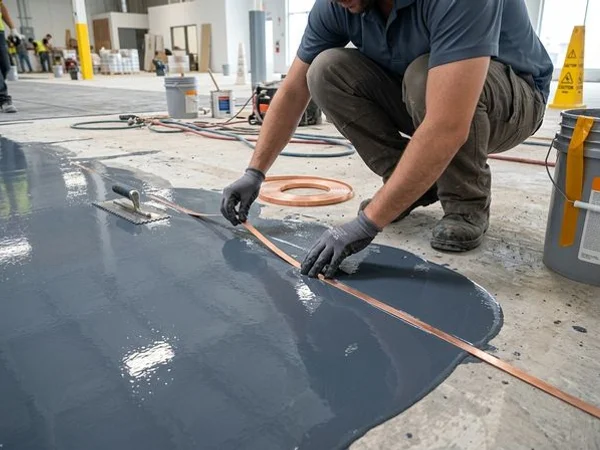
An ESD conductive epoxy floor solves this by turning the entire slab into a controlled conductor. Copper foil strips run in a grid across the prepared concrete, bonded to building ground, then buried under a 100% solids conductive base coat loaded with carbon black or carbon fibre. A static-dissipative topcoat closes the system. A calibrated megohmmeter confirms the finished floor sits inside your target range, typically between 10^4 and 10^9 ohms depending on whether you specified conductive or dissipative behaviour.
Every install we hand over meets NFPA 99 for healthcare and follows EOS/ESD Association guidelines, with the resistance log included in the compliance package. As Ottawa’s full-spectrum epoxy flooring contractor, we run ESD systems alongside our institutional and medical epoxy work for federal labs, hospitals, and Kanata electronics manufacturers.
What is Included
- Static-control spec review with your facilities or EHS team
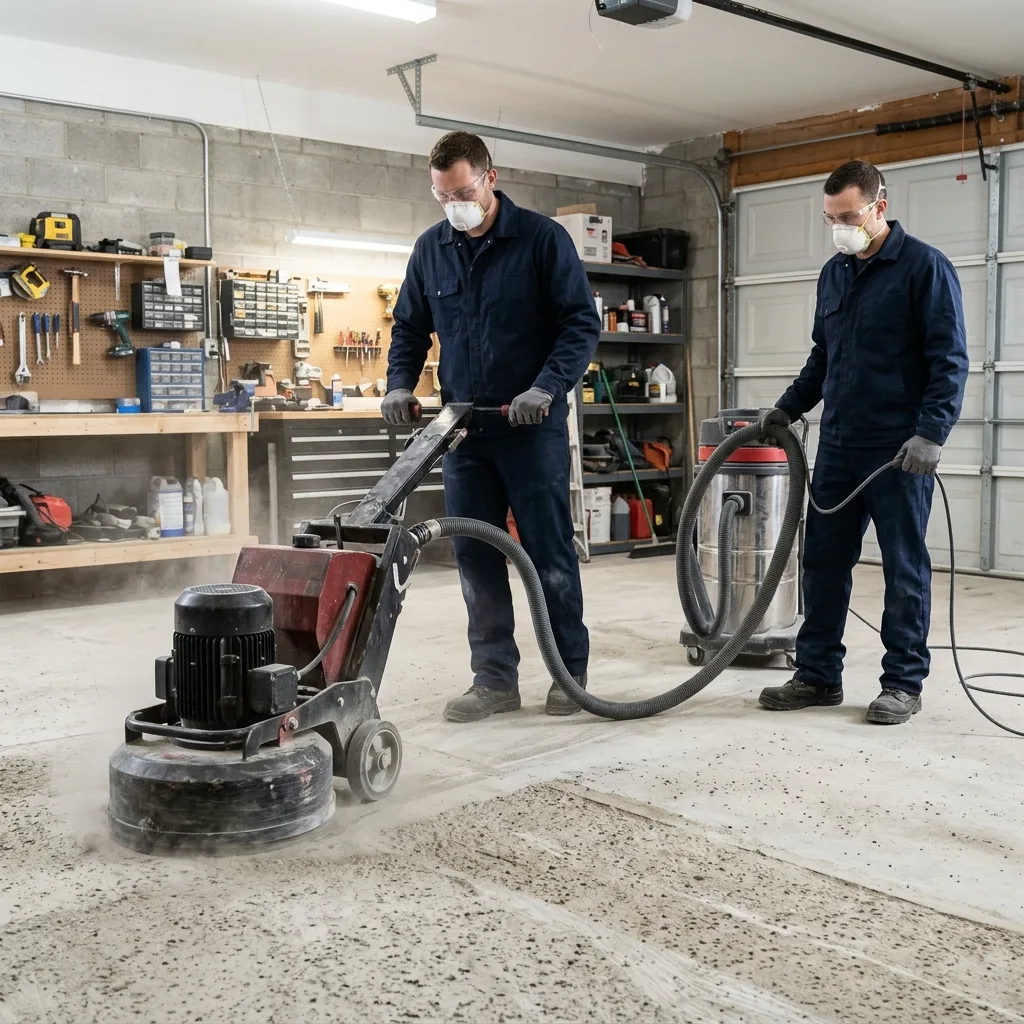
- Diamond-grind substrate prep to CSP 3 or higher
- Copper grounding strip grid laid to drawing
- 100% solids conductive base coat with carbon additives
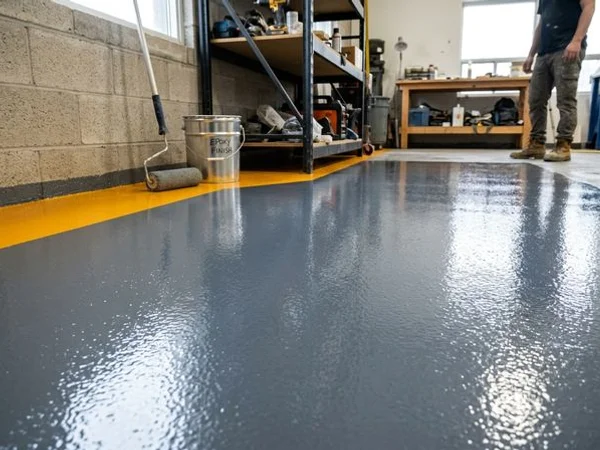
- Static-dissipative topcoat
- Point-by-point megohmmeter resistance mapping
- Signed compliance certificate at handover
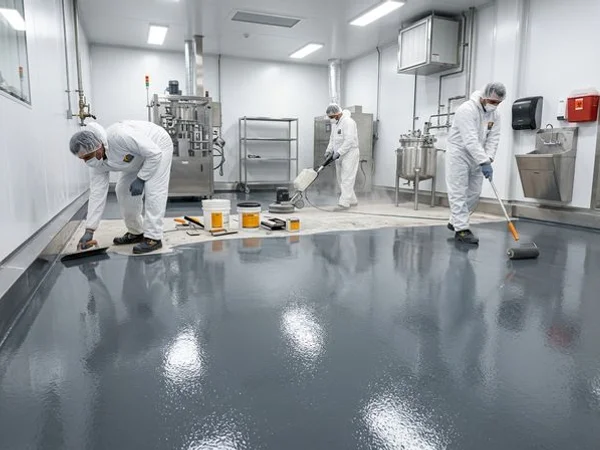
- Cleanroom-compatible sequencing where required
Which NCR Facilities Need ESD Flooring
Any operation combining sensitive electronics, flammable solvents, or life-safety equipment carries ESD risk from the day the doors open. A charge of a few hundred volts, released in nanoseconds, is enough to kill a surface-mount chip outright or seed a latent failure that surfaces months later in the field.
Two categories cover most requests. Conductive flooring targets 10^4 to 10^6 ohms, which is the specification for active grounding on electronics production lines and aerospace bench work. Dissipative flooring targets 10^6 to 10^9 ohms and provides controlled charge bleed without introducing shock risk near live circuits. NFPA 99 places hospital operating rooms firmly in the dissipative bracket.
In the National Capital Region, the workload skews toward Kanata’s technology corridor, where defence electronics suppliers and contract manufacturers routinely require ESD-compliant floors as a condition of their OEM audit programs. Federal and private data centres across the NCR are a growing category too, particularly where legacy raised-floor tile systems have failed or been reconfigured. Pharmaceutical and nutraceutical producers, hospital procedure suites, and university research cleanrooms round out the request list.
Copper Grounding Grid: Where the System Lives or Dies
Nothing else in the system matters if the copper grid cannot dump charge to building ground. Without a reliable path, the finished floor behaves as a capacitor rather than a conductor and every resistance test reads high.
The grid itself is copper foil, typically 2 inches wide, laid in a repeating pattern across the prepared slab. Spacing depends on floor area and resistance target, usually 24 to 48 inches on-centre. Each strip terminates at a bonding lug that ties into the facility’s electrical ground under Ontario Electrical Safety Code and ESA supervision. Before any copper goes down, the concrete is diamond-ground to CSP 3 or CSP 4 per ICRI guidelines. This is the step that budget contractors cut, and it is the reason most ESD floors fail their resistance mapping.
Once the grid is placed, we bond the strips with a conductive adhesive, lap the corners, and cover the assembly with a first coat of 100% solids conductive epoxy formulated with carbon black or carbon fibre. Subsequent build coats and the dissipative topcoat maintain a continuous resistance chain from surface through base to grid to ground.
Resistance Testing and Compliance Certification
Megohmmeter mapping is the only defensible way to prove an ESD floor is doing its job. ASTM F150 defines the point-to-point and point-to-ground test method. Readings are taken across the finished floor on a grid, typically every 100 to 200 sq ft, and every point has to sit inside the target window before we hand the floor over.
Each test point is logged with location, the reading, the instrument used, the ambient temperature and humidity (both influence the numbers), and the test voltage applied. The compliance certificate we sign ties those readings to the project address, floor area, system specification, and applicable standards.
For pharmaceutical operations, this documentation drops straight into the facility qualification package. For Kanata defence and electronics manufacturers, it satisfies OEM customer audit programs that will not accept unverified ESD compliance from their contract partners.
Material Selection for NCR Industrial and Cleanroom Environments
The base coat is almost always a 100% solids epoxy. That chemistry gives us the density and adhesion needed to encapsulate the copper grid and produce consistent resistance across the finished floor. Topcoat selection is where the specification actually diverges. In Ottawa, four chemistries handle most of what comes across our desk: standard conductive epoxy for dry electronics assembly, aliphatic polyurethane for chemical resistance in pharmaceutical operations, aliphatic polyurea for fast-turnaround phased installs, and novolac epoxy where aerospace or chemical processing exposure demands it.
Slab moisture is a persistent Ottawa problem, especially in below-grade or ground-level industrial buildings poured on Leda clay without a modern vapour barrier. ASTM F2170 in-situ probes are mandatory before any ESD system goes down. When a slab returns above 75% RH, a moisture-mitigating primer or full epoxy vapour barrier goes in as the first layer. That step adds $1.50 to $3.00 per sq ft, but skipping it guarantees osmotic blistering that destroys both floor adhesion and the conductive path within a couple of years.
Questions Facility Managers Ask
How much does ESD epoxy flooring cost per square foot?
For most Ottawa jobs, budget $12 to $22 per sq ft installed. Straightforward open-plan electronics floors on sound concrete land near the lower end. Cleanroom-grade topcoats, phased overnight installation, or moisture barrier work on older slabs push the number toward the top of the range.
Can ESD epoxy be applied over an existing epoxy or vinyl floor?
Almost never. The conductive path has to run continuously from floor surface through the base coat, through the grid, and to building ground. Any non-conductive layer in between breaks the chain and every resistance reading fails. Standard prep is shot blasting or diamond grinding back to bare concrete.
Does the ESA in Ontario regulate the grounding connection for ESD floors?
Yes. The copper grid ties into building ground, which is part of the facility’s electrical system regulated by the Electrical Safety Authority under the Ontario Electrical Safety Code. Any final ground connection made by a licensed electrician is coordinated as a separate scope. We provide the termination points and confirm accessibility before the base coat is poured.
What is the maintenance routine for an ESD floor?
Use ESD-safe, non-insulating cleaning agents only. Standard floor waxes and non-conductive strippers coat the surface with an insulating film that pushes resistance out of the acceptable range. Facilities should validate the cleaning protocol against the system specification and retest resistance annually or any time the cleaning chemistry changes.
Our ESD Epoxy Results in Ottawa
Why Ottawa Customers Choose Ottawa Epoxy Flooring for ESD Epoxy
NFPA 99 Compliant
Specified to NFPA 99 for healthcare occupancies and EOS/ESD Association guidelines for electronics and aerospace work.
Verified With Testing
Every finished floor is mapped with a calibrated megohmmeter and the readings are logged before we leave site.
Cleanroom Compatible
Low-particulate, seamless topcoats formulated for ISO Class 7 and pharmaceutical operations.
Full Documentation
Copper grid drawings, resistance test logs, and compliance certificates delivered with the invoice.
How ESD Epoxy Works
Static Spec Review
We sit down with your facilities or EHS team, confirm the target resistance window (10^4 to 10^9 ohms), and match it to your operations.
Substrate Prep
Diamond grinding to CSP 3 or higher. Conductivity fails without a clean, uniform bond plane.
Copper Grid + Conductive Base
Copper foil strips laid to drawing, adhered with conductive adhesive, then a 100% solids conductive base coat with carbon additives.
Test + Certify
Megohmmeter readings across every zone, logged with instrument, temperature, and humidity, tied to a signed compliance certificate.
Ready for a Free On-Site Assessment?
Same-day quotes across Ottawa. WSIB-certified, $2M liability on every project.
What Customers Say About Our ESD Epoxy
"Pharmaceutical cleanroom floor. Seamless, ESD spec, resistance testing came back inside the target range on the first pass."
"Electronics assembly build in Nepean. The floor cleared certification testing first time and the paperwork was tight enough to satisfy our OEM auditor."
"Hospital operating room. NFPA 99 compliant, on schedule, under budget."
ESD Epoxy FAQs
Conductive versus dissipative: which does my facility need?
Conductive systems sit at 10^4 to 10^6 ohms and actively drain charge to ground, which suits electronics assembly and aerospace bench work. Dissipative systems sit at 10^6 to 10^9 ohms and bleed charge slowly enough to eliminate shock risk near live circuits, which is why NFPA 99 hospital operating rooms specify them. We pick the range during the spec review, before any material is ordered.
Do you install the copper grounding grid yourselves?
Yes. Copper foil strips are cut, laid to the design drawing, bonded to a facility ground lug, and encapsulated under the conductive base coat. It is all in scope. If a licensed electrician needs to make the final bond to building ground under the Ontario Electrical Safety Code, we coordinate that with your ESA-registered contractor.
How is the floor proven to work?
Point-by-point megohmmeter readings across the finished floor, typically every 100 to 200 sq ft. Each reading is logged with location, instrument, temperature, and humidity, then attached to the compliance certificate.
Can this go into a cleanroom?
Yes. Seamless, low-particulate topcoats are the standard for ISO Class 7 and comparable environments. Section-by-section sequencing keeps adjoining rooms in operation.
Which Ottawa facilities usually need ESD floors?
Electronics contract manufacturers and defence electronics suppliers in Kanata, pharmaceutical and nutraceutical producers, federal and private data centres across the NCR, hospital procedure suites, and aerospace component facilities. Anywhere static discharge can damage a component, ignite a vapour, or violate NFPA 99.
What does ESD conductive epoxy cost in Ottawa?
Budget $12 to $22 per sq ft installed. Floor area, existing slab condition, grid density, and cleanroom-grade topcoat requirements move the number. Every quote follows a site visit and comes as a written RFQ.
How long does an installation take?
Plan for three to five days on a 5,000 to 10,000 sq ft facility. Day one is diamond grinding and prep. Days two and three cover copper grid layout and the conductive base coats. Days four and five are the dissipative topcoat and cure time before megohmmeter testing.
How does ESD epoxy compare with ESD tile or ESD vinyl?
Modular ESD tile and vinyl are replaceable, but every seam collects contamination, which is a hard fail in pharmaceutical cleanrooms and PCB assembly. Seamless epoxy has no joints, bonds directly to the slab, and delivers more uniform resistance across the full floor.
What warranty is included on ESD flooring?
A written warranty covering adhesion, conductivity performance, and surface integrity. Resistance readings are documented at handover; if the floor moves outside the specified window during the warranty period, we remediate at no cost.
Does the slab need to be dry before ESD epoxy goes down?
Yes. Slab moisture drives osmotic pressure that breaks the epoxy bond and shorts out the conductive path through the grid. We test with ASTM F2170 in-situ probes before any coating is ordered.
Can ESD floors be installed in occupied Ottawa buildings?
Yes, with phased scheduling. The floor is divided into zones and worked one at a time so adjacent operations continue. HEPA-filtered air scrubbers manage odour and particulate.
Which standards apply to ESD epoxy in Ontario?
ASTM F150 for point-to-point and point-to-ground resistance, NFPA 99 for healthcare occupancies, and EOS/ESD Association S7.1 for flooring materials. Ontario's ESA regulates the connection between the copper grid and building ground under the Ontario Electrical Safety Code.
Related Services
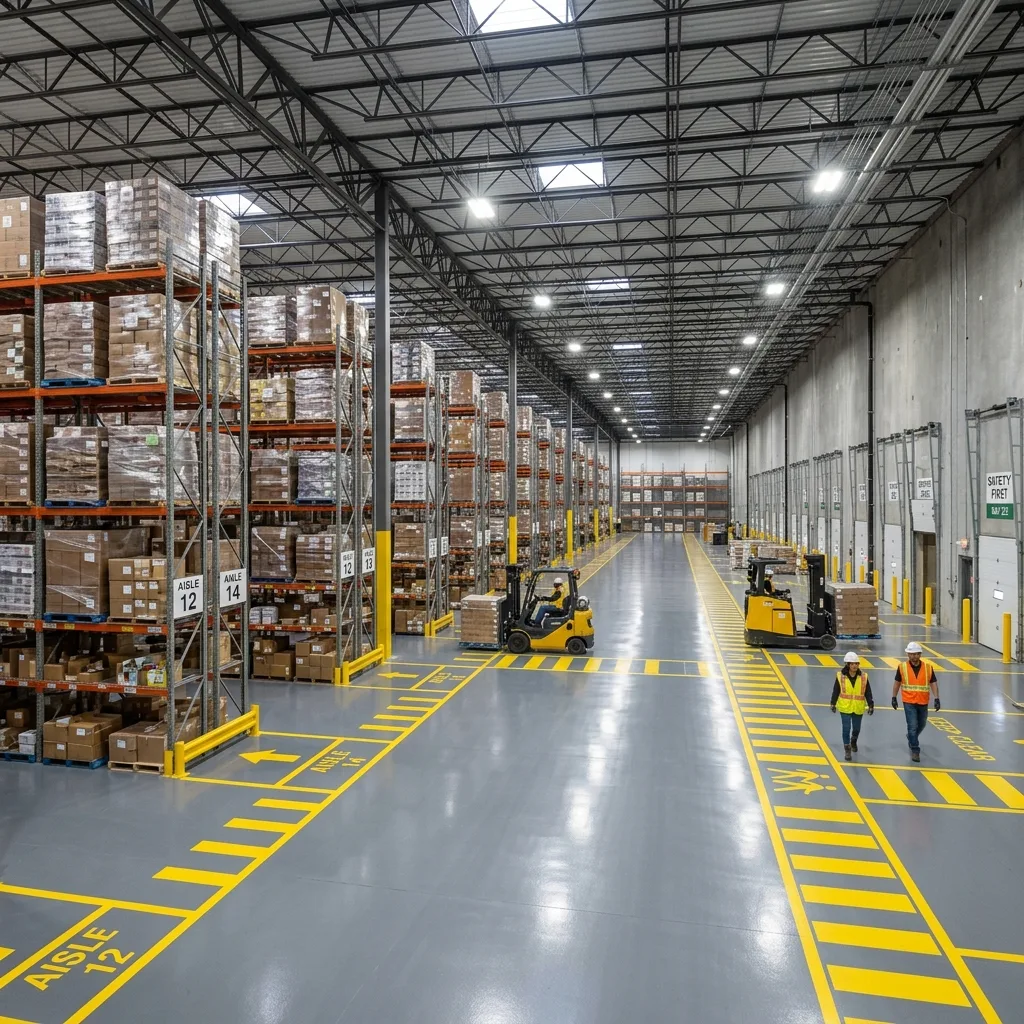
Commercial & Industrial Epoxy Flooring in Ottawa & the National Capital Region
Shot-blasted 100% solid commercial-grade epoxy systems built for manufacturing plants, distribution centres, and 24-hour food operations across Ottawa. Installed pricing runs $10 to $15 per sq ft with off-hours scheduling that returns your floor before the next shift starts. WSIB-certified crews, $2M liability, and full compliance documentation on every project.
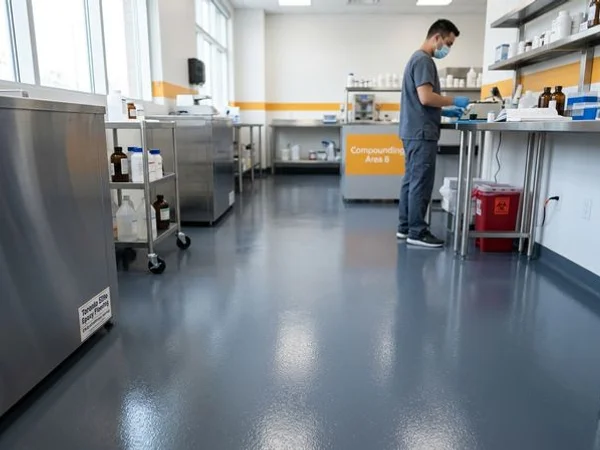
Institutional & Medical Epoxy Flooring in Ottawa & the National Capital Region
Seamless antimicrobial epoxy with 4 to 6 inch integral wall coving and zero-VOC chemistry for Ottawa hospitals, clinics, schools, and long-term care operators. Installed pricing $6 to $12 per sq ft; section-by-section scheduling keeps the facility running. WSIB-certified crews, $2M liability, and full IPAC Canada compliance paperwork on every project.

Warehouse Epoxy Flooring in Ottawa & the National Capital Region
Forklift-rated 100 percent solid epoxy systems with shot-blast prep, chemical-resistant topcoat, and embedded aisle marking for NCR distribution centres, logistics hubs, and federal warehouse operations. From $3 to $7 per sq ft installed, phased weekend windows keep operations running, WSIB-certified crews and $2M liability on every commercial project.
Ready to Book ESD Epoxy?
Same-day free on-site assessment. WSIB-certified, $2M liability on every project.